DEVICES & HARDWARE
Partow produces photonic devices based on TFLN technology. A rib layer is directly etched on top of the electro-optic thin film layer to form the optical waveguide. The high index contrast waveguide has sub-micron mode size which requires couplers for coupling to the device. This high index contrast platform allows us to make advanced photonic components such as compact Mach-Zehnder modulators, micro-ring modulators and nonlinear optical devices. Partow is currently developing these devices.
We provide lithium niobate device processing. Here are the processes available:
-
TFLN waveguide fabrication with loss <1dB/cm at 1550nm
-
TFLN poling with periods as small as a few microns
-
TFLN coupler with less than 3dB coupling loss
-
TFLN device passivation and electrode deposition
-
Au electro-plating for high-speed transmission line
-
A library of devices including couplers, micro-ring resonators, MMI couplers and Mach-Zehnder modulators is available upon request.
-
For other wavelengths, the design of waveguides, couplers, etc. is available upon request
E-field Micro-Ring Sensor
Partow E-field Micro-Ring (MR) sensor products use electro-optic micro-ring resonators made from lithium niobate thin films for sensing of electric fields. The sensors can achieve very high spatial resolution and can operate from near DC frequencies up to 2.5 GHz. The sensor is made from all dielectric materials, hence it does not perturb the measurand electric field. Also, since fiber optic cables are used, these sensors are immune to electromagnetic interference and can be used in highly noisy environments. The readout system is based on a tunable laser and a detector. The sensor operates at an eye-safe wavelength of 1550 nm and produces a voltage proportional to the measurand electric field.
Mach-Zehnder THz Receiver
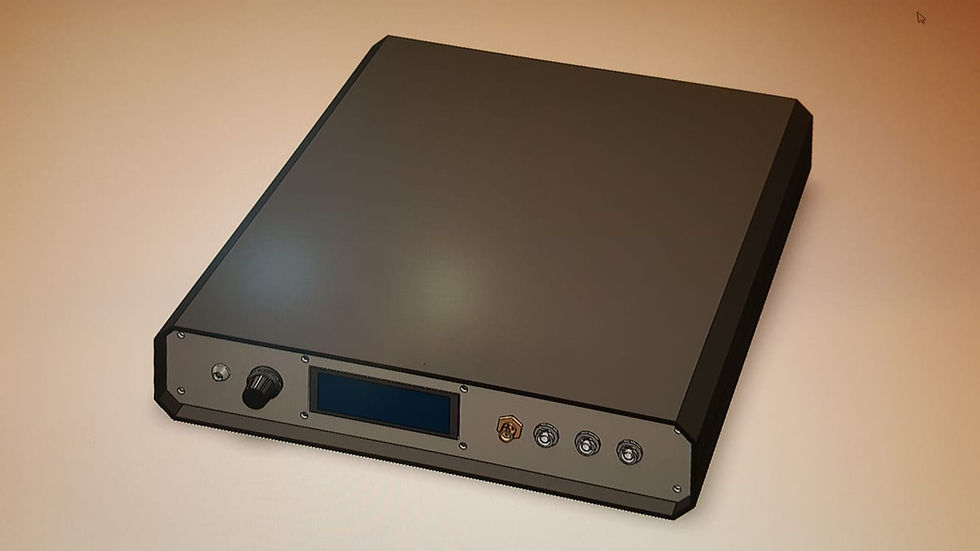
Partow’s thin-film lithium niobate Mach-Zehnder modulator sensors are designed for broadband electro-optic detection from DC up to several terahertz. Built entirely from dielectric materials, the sensor element does not perturb the measurand field, and the all-fiber connection makes it immune to electromagnetic interference. The interrogation system uses a tunable 1550 nm laser source and balanced detection to deliver high sensitivity with picosecond rise time
Tunable femtosecond laser
Partow femto-second laser system uses an all-fiber robust construction approach. The system uses a nonlinear polarization rotation method to achieve extremely short pulses. No moving parts are used in the system. The pulses are transform-limited. Depending on the application, Partow provides two different systems — one with low power and one with high power.